
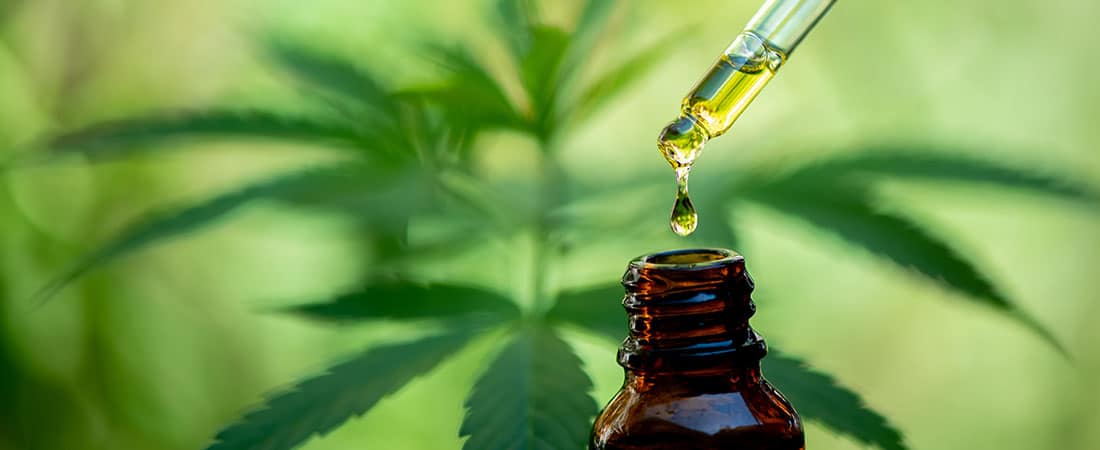
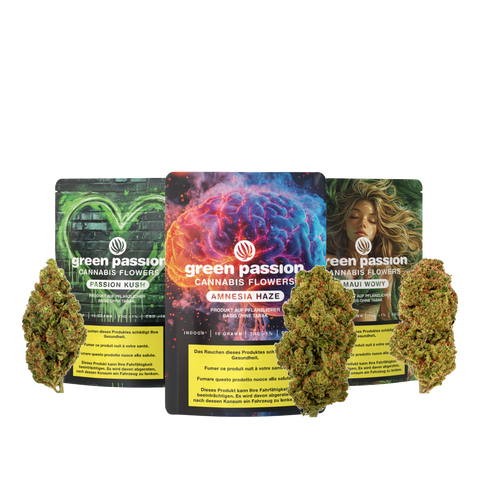
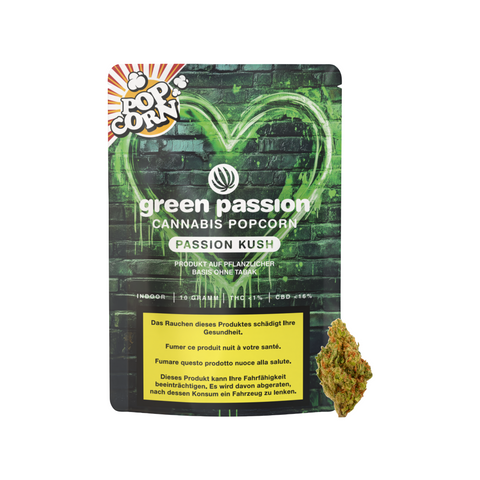
When you make your own CBD oil, you’re not just creating a promising product, but also a super versatile cannabis product. Our tip: use high-quality CBD buds from Green Passion to treat yourself even better and to easily use the whole flower. With a simple step-by-step guide, we’ll show you how to make your own CBD oil and which cannabis strains work best for it.
What is CBD oil?
First, it’s important to clarify what CBD oil or CBD drops actually are. CBD drops are made by gently heating (basically infusing) cannabis in a “carrier oil.”
You can use different oils as a carrier, but coconut oil and hemp seed oil are the most popular and common ones. Both taste good and are great for your skin. That makes them versatile options for both medical and topical uses. Plus, both have strong natural antifungal and antimicrobial properties. This helps prevent mold and extends the shelf life of your CBD oil. Coconut oil actually has even more saturated fats, which bind the fat-loving cannabinoids even better than hemp seed oil.
The cannabis plant is known to contain several cannabinoids. The two most active components, CBD and THC, are both hydrophobic. That means they don’t like water and are repelled by water molecules. On the other hand, they’re both fat-soluble and love to bind with fatty acid molecules—like those found in oil. So, when cannabis is soaked in oil, the THC and CBD molecules leave the buds or plant material and bond with the oil instead.
Both hemp plants and CBD buds are suitable for making cannabis oil
In Switzerland, you have two options for which cannabis plants to use for your homemade CBD oil. For example, you could use a hemp plant, but you could also use a CBD plant. Both can be legally grown in Switzerland. Compared to hemp, which contains low levels of CBD and THC, a CBD plant—or CBD buds—has a much higher CBD content. For this legal variety in Switzerland, the THC content is always less than 1%. Which plant you use to make CBD drops is a personal choice, but it does affect the final result and its cannabinoid content.
In general, CBD isn’t psychoactive compared to THC. But with the legally allowed THC content in Switzerland being less than 1%, that doesn’t really matter, since it’s too low to have any psychoactive effect. In the CBD shop from Green Passion, you’ll find different cannabis products with low THC content (<1%).
Even though both substances have their own remarkable benefits, an oil or balm that contains both CBD and THC has the greatest potential for a wide range of health benefits (even if it’s illegal in some countries). The so-called “entourage effect” means that the synergistic combination of THC and CBD is stronger than either one alone.
Difference between using raw and decarboxylated cannabis for oil making
The difference between raw and decarboxylated cannabis is mainly in the cannabinoid compounds. In raw cannabis, the cannabinoid compounds are THCA and CBDA. When you heat or vaporize cannabis, the compounds become THC and CBD—the same ones you get when you inhale cannabis. The process of heating and “activating” cannabis is called decarboxylation.
But you need to be careful when heating and ideally use low temperatures, going slow and steady, otherwise you risk overheating or underheating the cannabis. This can lead to uneven activation of THC and CBD, or even destroy both cannabinoids completely.
The easiest way to decarboxylate cannabis is in the oven. Once you add the cannabis to the oil, make sure you use a very low temperature to avoid further decarboxylation. You could also decarboxylate raw cannabis at the same time as infusing it with oil on the stove. But that requires much more careful monitoring to get the timing and temperature right and not ruin the oil. That’s why it’s best to use decarboxylated cannabis when making your own CBD oil.

How to make your own CBD oil
The most important thing when making CBD drops is not to overheat it. To avoid this, you could just add decarboxylated cannabis to the oil and let it sit at room temperature (in the dark) for several weeks, instead of heating it at all. The heat in the recipe below just helps speed up the extraction process and binds the cannabinoids to the oil. Since the recipe already uses decarboxylated cannabis, it’s enough to heat it between 50° and 80°C. At lower temperatures, the already active THC and CBD, as well as the terpenes, are preserved.
This is where a double boiler or a slow cooker (with a low temperature setting) comes in! With a regular pot on the stove, it's much harder to heat the oil without overheating it, even on the lowest flame. Plus, you get “hot spots” that can destroy those precious cannabinoids. You can keep an eye on the oil with a probe thermometer. Since oils have a higher boiling point than water, they often don’t seem as hot as they really are. For example, the oil can be well over 100°C, but it won’t visibly bubble and boil like water would at the same temperature.
Step-by-step instructions
- If your cannabis isn’t decarboxylated yet, grind or break it up into pretty small pieces. Spread it evenly on a baking sheet and heat it in the oven at 120°C for 25 to 30 minutes. For strains high in THC, heat it at the same temperature for 50 to 60 minutes. Or go for 45 minutes for balanced THC/CBD strains.
- Next, add water to the bottom pot of your double boiler and a cup of coconut oil to the top part. Heat it up until it melts. You can also do this on low/warm in a regular pot.
- Stir 7-10 grams of decarboxylated cannabis into the melted oil. You could also add a few grams of ground cannabis here.
- Heat the cannabis and oil on low for 30 to 60 minutes, stirring occasionally. You can keep this going for several hours, though many recipes only call for 20 to 30 minutes. You can check the temperature with a fever thermometer. The key is not to let the oil go over 90°C. We’re aiming for a target temperature of about 55°C – 65°C and let the oil infuse for an hour.
- When time’s up, line a strainer with cheesecloth and set it over a glass bowl. Then pour the cannabis and oil mixture through the strainer and gently squeeze out the excess oil from the cannabis using the cheesecloth. Careful: The oil will be hot and your hands will get greasy, so it’s best to wear food-safe gloves.
- Then pour the strained cannabis oil into a storage container. It’s best to use a glass container with a tight-fitting lid. Store the finished oil in a cool, dark place or – once it’s cooled down – in the fridge.
Homemade CBD oil usually gets used up within six months to a year. The effects can fade a bit over time, since THC naturally turns into the sleepy cannabinoid CBN. But as long as it doesn’t get moldy, the oil won’t really go bad.
Potency can vary with homemade CBD oil
Without lab testing, it’s tough to know the exact potency (THC and CBD content) of homemade cannabis products. If you’re using homegrown cannabis, you probably don’t know the exact strength of the strain, and even if you do, the plants can vary a lot depending on how they were grown, harvested, dried, or stored. Plus, phenotypes (different plant variations) can make a difference too.
With cannabis bought at a pharmacy that’s been tested for THC and CBD content, the potency of your final product also depends on how old the plant is, how you stored it, or the time and temperature you used for decarboxylation.
Source:









Comments (0)
There are no comments for this article. Be the first one to leave a message!