
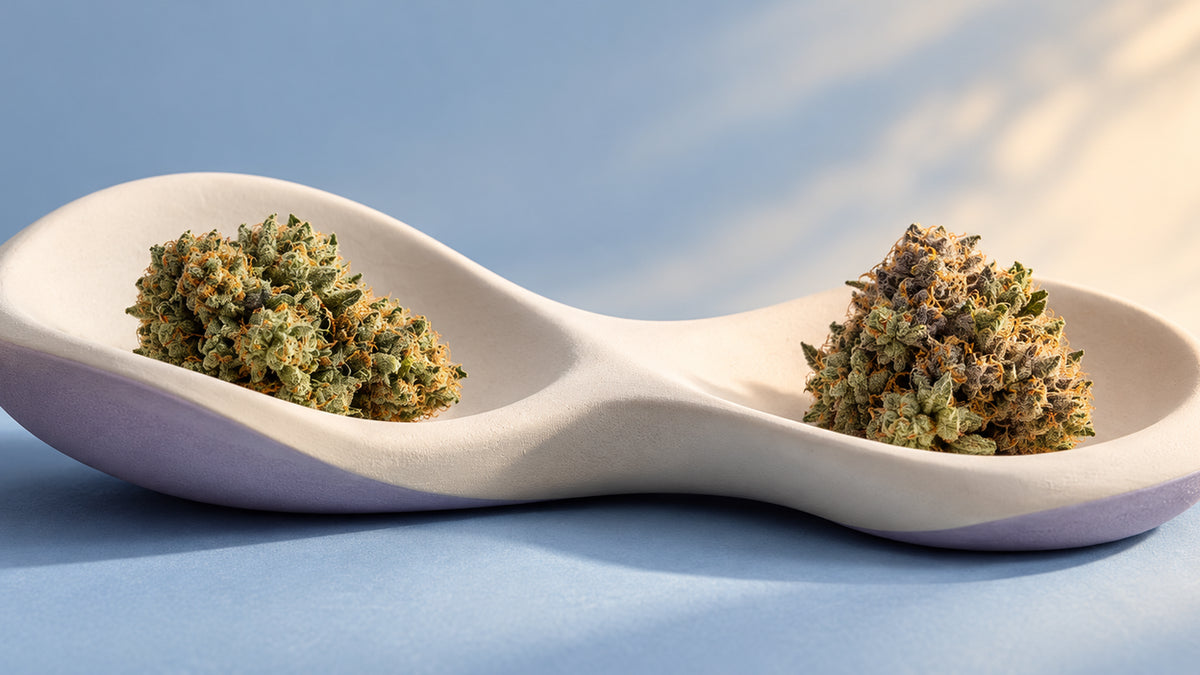
The CBD content and THC content of a cannabis flower show what percentage of its dry weight consists of these two cannabinoids. CBD-dominant flowers contain a lot of CBD and little THC, at Green Passion for example 11 to 20 percent CBD and 0.5 to 0.9 percent THC. THC-dominant flowers contain a lot of THC and hardly any CBD. In Switzerland, hemp flowers with a total THC content of 1.0 percent or more are classed as narcotics.
Which group a flower belongs to is determined mainly by the genetics of the strain. You can tell the content from the declaration on the packaging and on the product page. Here you can read how these figures come about, how to compare them and which values the strains in our range have.

CBD content: what the percentage means
The percentage refers to the weight of the dried flower. A flower with 18 percent CBD contains around 180 milligrams of CBD per gram. At 0.8 percent THC, that is around 8 milligrams of THC per gram. The two figures are usually shown side by side, because only the pair shows which group a strain belongs to.
In the fresh plant, CBD and THC are present almost entirely as acids: CBDA and THCA. With heat and time, these acids release carbon dioxide and turn into CBD and THC. That is why laboratories include the acid form in their calculation. The result is called total CBD or total THC. To get it, the acid content is multiplied by a factor of 0.877 and added to the free cannabinoid. The factor comes from the difference in weight between the two molecules.
A CBD value always belongs to a specific harvest. Flowers of the same strain can vary slightly from batch to batch. A difference of one to two percentage points is normal for natural products.
What is the difference between THC-dominant and CBD-dominant flowers (CBD flowers vs. THC flowers)?
The difference lies in the genetics. In the plant, CBD and THC are formed from the same precursor, cannabigerolic acid (CBGA). An enzyme converts this precursor into either CBDA or THCA. Which enzyme a plant produces depends on its genes.
The research group led by Etienne de Meijer described this in 2003 in the journal Genetics. When pure CBD plants were crossed with pure THC plants, a single gene locus appeared that controls the ratio. This results in three groups, which experts call chemotypes:
- THC-dominant: a lot of THC, hardly any CBD.
- Mixed: CBD and THC in a similar range.
- CBD-dominant: a lot of CBD, little THC.
A high CBD content and a high THC content therefore largely rule each other out in one flower. Over many years, breeders have selectively chosen CBD-dominant lines and crossed them further. How these strains came about is shown in our article on the history of CBD-dominant cannabis strains.
For trade in Switzerland, only the 1% limit for total THC counts, which is why Green Passion only sells flowers below this value.
THC content below 1 percent: what applies in Switzerland
The relevant law is the Narcotics Directory Ordinance of the FDHA (BetmVV-EDI, SR 812.121.11, as of 13 March 2026). Directory d in Annex 5 lists hemp plants or parts of them with an average total THC content of at least 1.0 percent. The same applies to objects and preparations with 1.0 percent total THC or more. Cannabidiol is not listed as a narcotic in the ordinance.
The key term is total THC. The limit applies to THC and THCA together. A flower with 0.3 percent free THC and a lot of THCA can therefore be above 1.0 percent. Reliable declarations therefore state the total value.
Other countries have other limits. In Germany, the limit for industrial hemp is 0.3 percent THC (KCanG § 1 No. 9). A product that falls under the 1% rule in Switzerland can therefore count as a narcotic abroad. The CBD flowers at Green Passion are declared with a THC content below 1 percent and are only sold to people aged 18 and over.
How do I know whether cannabis flowers have a high CBD or THC content?
The declaration is the most reliable source. The packaging and the shop show the CBD and THC content in percent. You cannot see or smell the content. Resinous, dense flowers can contain little CBD, loose flowers a lot. For a good assessment, it is worth looking at four points.
Declaration on the packaging and product page
For every flower from Green Passion, the product page shows the CBD, THC and CBG content in percent. If a package only states a CBD value without a THC value, half of the information is missing. Also check whether the total value is meant.
Strain and genetics
The strain name gives a first clue. CBD lines often carry well-known names such as Amnesia Haze or Lemon Skunk, but have their own CBD-dominant genetics. The name alone therefore says nothing about the content. What matters is the breeding line the plant comes from.
Cultivation
Light, nutrients and the time of harvest influence how many cannabinoids a plant produces. Indoor cultivation delivers very consistent harvests, while outdoor flowers vary more from year to year. However, genetics set the framework. A CBD strain does not become a THC strain through cultivation. You can read more about the types of cultivation in the comparison CBD indoor, outdoor or greenhouse.
Origin of the product
For goods without a declaration, the content can only be determined by a chemical analysis. So buy flowers that state the strain, cultivation and content.
CBD THC ratio: how to read the figure
Some products state a ratio instead of two percentages. The figure CBD:THC 20:1 means that the product contains twenty times more CBD than THC. With THC:CBD, THC comes first, so 1:20 means the same. Always check first which cannabinoid comes first.
You can calculate the ratio yourself from the percentages. Divide the CBD content by the THC content:
- White Passion: 20 percent CBD and 0.8 percent THC give 25:1.
- Passion Kush: 16 percent CBD and 0.9 percent THC give around 18:1.
- Velvet Passion: 11 percent CBD and 0.5 percent THC give 22:1.
A ratio says nothing about the absolute amount. Two flowers with 20:1 can contain 10 or 20 percent CBD. There is no "best" ratio. When comparing flowers, the two percentages tell you more.
Flowers with a high CBD content in our range
The following values come from the product data of the CBD flowers in the shop (as of October 2026). They can change with a new harvest. The figure on the product page always applies.
| Strain | Cultivation | CBD | THC | CBG |
|---|---|---|---|---|
| White Passion | Outdoor | 20% | 0.8% | 0.8% |
| Gorilla Smack | Indoor | 19% | 0.7% | 0.7% |
| Passion Haze | Greenhouse | 19% | 0.7% | 0.4% |
| Maui Wowy | Indoor | 18% | 0.9% | 0.9% |
| Alpina Green | Outdoor | 18% | 0.8% | 0.8% |
| Orange Passion | Indoor | 17% | 0.8% | 0.9% |
| Fruit Punch | Indoor | 17% | 0.8% | 0.8% |
| Passion Kush | Indoor | 16% | 0.9% | 1.5% |
| Amnesia Haze | Indoor | 16% | 0.8% | 0.6% |
| Maui Kush | Indoor | 15% | 0.7% | 0.8% |
| Space Queen | Indoor | 14% | 0.7% | 0.6% |
| Lemon Skunk | Indoor | 13% | 0.6% | 0.5% |
| Velvet Passion | Indoor | 11% | 0.5% | 0.7% |
Two products fall outside this range. CBD Moonrocks are flowers coated with extract and rolled in kief, declared with 70 percent CBD. Freedom Flower is a CBG flower with 10 percent CBG, 0 percent CBD and 0.2 percent THC. This strain shows well that genetics do not only decide between CBD and THC.
THC content and CBD content in hash
Hash consists of the resin of the flower. During production, the resin glands, the trichomes, are separated from leaves and stems and pressed. Because the cannabinoids sit almost entirely in these glands, the content in hash is usually higher than in the flower of the same plant. This applies to CBD and to THC. For CBD hash to stay below 1 percent total THC, the starting material must already contain very little THC.
In the CBD hash range, the declared values are between 16 and 35 percent CBD with 0.4 to 0.9 percent THC:
- Manali Cream: 35 percent CBD, 0.9 percent THC
- Charas Passion: 32 percent CBD, 0.6 percent THC
- Super Pollen: 31 percent CBD, 0.4 percent THC
- Black Afghan and Red Lebanese: 26 percent CBD each, 0.4 and 0.8 percent THC
- Golden Maroc: 16 percent CBD, 0.4 percent THC
The differences depend on the starting material and the method, such as dry sieving or ice water. How dry sift, pollen and bubble hash are made is explained in the article on CBD hash varieties and production.
Terpenes: the aroma alongside the cannabinoid content
Two flowers with the same CBD content can smell very different. Terpenes are responsible for this. These aromatic compounds occur in many plants, for example in citrus peel, hops or lavender. More than a hundred different terpenes have been described in cannabis.
Some common terpenes and their typical scent:
- Myrcene: earthy, slightly fruity, also found in hops and mango
- Limonene: fresh citrus
- Beta-caryophyllene: peppery and spicy, also found in black pepper
- Linalool: floral, reminiscent of lavender
- Pinene: resinous, like pine needles
Terpenes are usually not declared in percent. Instead, the product pages give a description of the aroma, for example "tart and spicy" for White Passion. If two strains have similar CBD values, the aroma helps you choose. Terpenes are volatile. Stored cool, dark and airtight, the aroma lasts longer.


Comments (0)
There are no comments for this article. Be the first one to leave a message!