
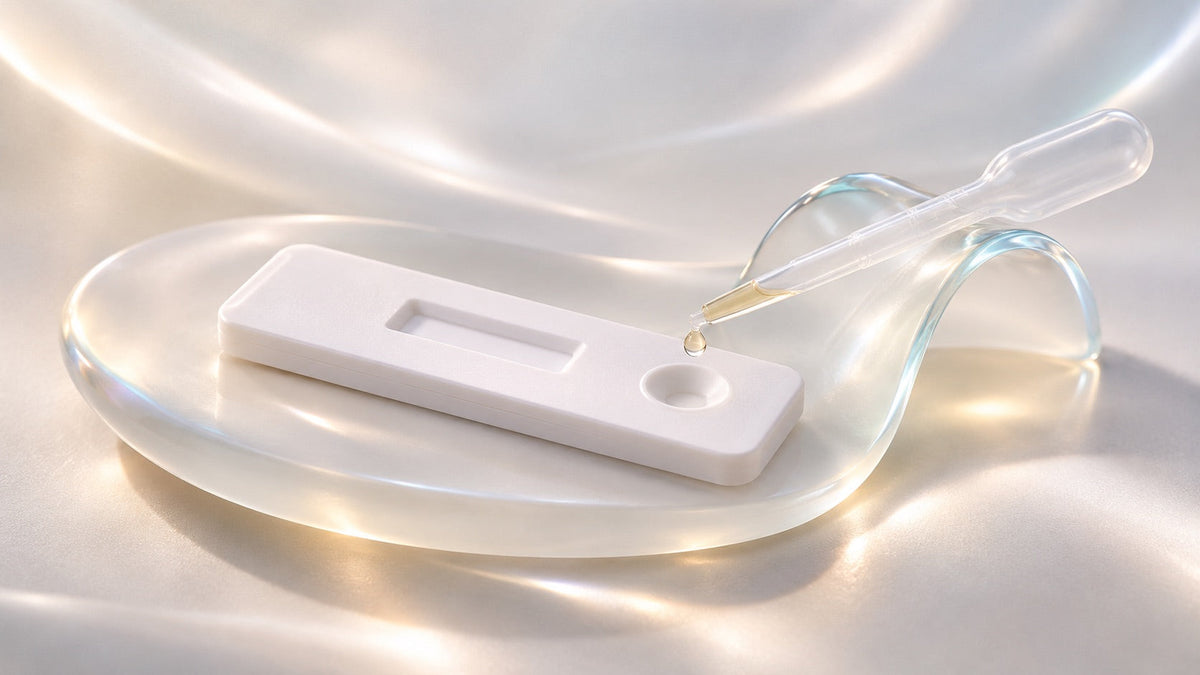
A urine test for THC looks for the metabolite THC-COOH. It shows that your body has processed THC in the past days or weeks, but not when. The THC breakdown calculator estimates roughly how long this takes for you. This guide explains the procedure, cut-off values and what the result tells you.
Rapid test and lab analysis
There are two stages. The rapid test is an immunoassay, usually in the form of a test strip or cup: antibodies react to THC-COOH, and the result is available after a short time. The lab analysis separates the substances using gas chromatography or liquid chromatography and identifies them unambiguously with mass spectrometry. A positive rapid test is therefore only considered confirmed once the lab verifies it.
Which cut-off values apply
The guidelines of the US agency SAMHSA (2017) are the most widely used international reference. According to them, a screening test counts as positive from 50 ng/ml THC-COOH, the confirmation analysis from 15 ng/ml. The resulting detection times are shown in the guide THC in urine.
Where urine tests are used in Switzerland
In road traffic, the police may carry out preliminary tests under Art. 10 of the Road Traffic Control Ordinance, notably in urine, saliva or sweat, if there are signs of unfitness to drive. If the preliminary test is positive, a blood sample follows. Only the blood sample serves as evidence, and the decisive threshold is the limit for THC in blood. Urine samples are also used in traffic-medical assessments of fitness to drive and in abstinence checks.
What a positive result means
A positive urine test proves that THC-COOH is above the test cut-off. It says nothing about when THC was consumed, in what amount, or whether THC is currently circulating in the blood. Conversely, a negative test doesn't reliably rule out contact with THC if the level is below the cut-off.
Diluted samples and creatinine
Labs measure the creatinine level in every sample. According to Moeller and colleagues (2008), a sample is considered diluted if creatinine is below 20 mg/dl. A diluted sample is not counted as negative but is usually repeated. Why the breakdown itself can't be sped up is explained in the guide THC breakdown.
CBD products and THC detection
In Switzerland, CBD products may contain less than 1 percent total THC, as regulated by the FDHA Narcotics Control Ordinance (BetmVV-EDI, SR 812.121.11, as of 2026). This means they are not free of THC. A urine test reacts to THC-COOH and doesn't distinguish which product the THC came from. What this means for road traffic is explained in the guide CBD and driving in Switzerland.
Frequently asked questions about urine tests for THC
At what level is a urine test for THC positive?
According to the SAMHSA guidelines (2017), from 50 ng/ml THC-COOH in the screening test and from 15 ng/ml in the confirmation analysis.
Is a urine test proof in Swiss road traffic?
No. It is a preliminary test under Art. 10 SKV. The blood sample is the evidence.
Can a rapid test be a false positive?
Yes, immunoassays can react to other substances. That's why a lab confirms every positive result with mass spectrometry.
Sources
- SAMHSA: Mandatory Guidelines for Federal Workplace Drug Testing Programs, Urine. Federal Register 82 FR 7920, 23 January 2017.
- Moeller KE, Lee KC, Kissack JC: Urine drug screening, practical guide for clinicians. Mayo Clinic Proceedings 2008; 83(1): 66–76.
- Road Traffic Control Ordinance (SKV, SR 741.013), Art. 10 para. 2. Fedlex, as of 2026.
- FEDRO Ordinance on the Road Traffic Control Ordinance (VSKV-ASTRA, SR 741.013.1), Art. 34, and Traffic Rules Ordinance (VRV, SR 741.11), Art. 2 para. 2. Fedlex, as of 2026.
Information as of: November 2026. This guide is a factual summary of published sources and does not replace legal or medical advice.


Comments (0)
There are no comments for this article. Be the first one to leave a message!