
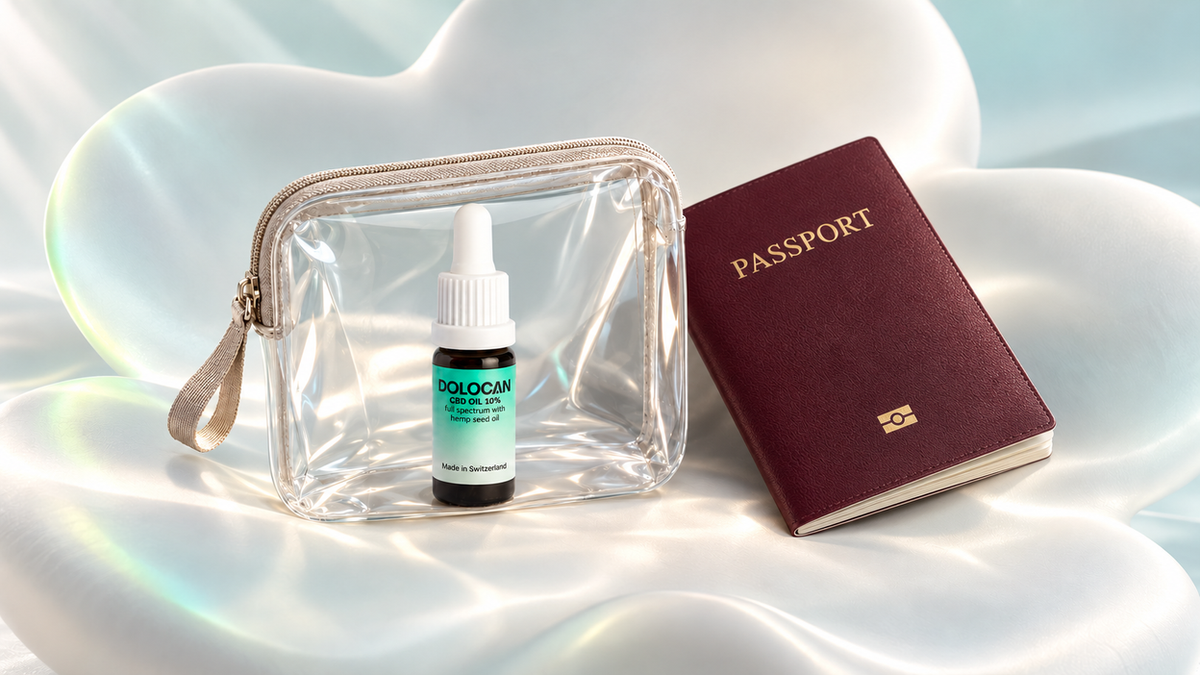
There is no uniform rule for travelling with CBD. In Switzerland, hemp products below 1.0% total THC are not narcotics. As soon as you cross the border, the law of the destination country applies, and on flights with a connection also the law of the transit country. Most neighbouring countries have lower THC limits than Switzerland. On top of that come the airport security rules for liquids and battery powered devices.
Taking CBD on a plane: what decides
There is no specific aviation rule for CBD. Whether you can take it on a plane depends on two questions. The first question is legal: is the product allowed in the country of departure, the transit country and the destination country? The second question is about security: does the product meet the rules for liquids, batteries and dangerous goods?
The first question is the more important one. A CBD oil with 0.8% THC is not a narcotic in Switzerland. In Germany or Austria, it is above the local limit of 0.3%. The Swiss federal authorities' fact sheet on CBD products expressly points out that stricter regulations and different THC limits abroad can lead to criminal prosecution (fact sheet on products containing CBD, version 8.0, as of 1 May 2025). The Swiss rule is explained in detail in the article on the 1% rule in Switzerland.
CBD at airport checks
There are two different checks at the airport. Security screening checks hand luggage for prohibited items, liquids and dangerous goods. Customs checks which goods are imported or exported when crossing the border.
At the Swiss border, the Federal Office for Customs and Border Security (BAZG) is responsible for narcotics. According to the BAZG, customs offices help monitor the import, export and transit of narcotics. If they detect a violation, they call in the competent authority, for example Swissmedic or the police. For CBD products below 1.0% total THC, Swiss narcotics law does not apply. This may be different in the destination country. There, the authority decides under its own law, including on seizure.
CBD liquid on a plane and battery powered devices
At the airport, CBD liquids, vape pens and disposable vapes are subject to the same rules as other liquids and electronic devices. At Zurich Airport, the following applies according to the airport (retrieved on 23 October 2026):
- When departing from Zurich, liquids in containers of up to 2 litres are allowed in hand luggage.
- For transfer passengers, the limit of 100 ml per container in a 1 litre bag still applies.
- Rechargeable batteries, batteries, power banks and e-cigarettes must go in hand luggage.
- Power banks are limited to two, each with a maximum of 100 Wh.
Other airports and airlines have their own rules. At many airports, the 100 ml limit applies to all passengers. Check the rules for your departure and return airport before you travel. A vaporizer or vape pen with a battery always belongs in your hand luggage and not in your suitcase. You will find an overview of devices and cartridges in the CBD vape category.
CBD oil when travelling
At security screening, CBD oil counts as a liquid. A bottle of less than 100 ml also meets the hand luggage requirement at airports where the old liquids rule still applies. It must then go into the 1 litre bag together with the other liquids.
Legally, the THC content is what matters for oil. Full spectrum oils contain other hemp compounds and some THC in addition to CBD. In Switzerland, this is permitted up to below 1.0% total THC. Abroad, lower limits often apply. Before you travel, compare the THC value on the label with the limit in the destination country. You will find the oils in our range in the CBD oil category.
Taking CBD from Switzerland to Germany
Germany regulates hemp in the KCanG. Under § 1 no. 9 KCanG, hemp only counts as industrial hemp if two conditions are met (as of: amendment of 20 June 2024):
- The handling of the hemp serves exclusively commercial or scientific purposes that rule out misuse. Cultivation is excluded from this.
- The hemp comes from cultivation in an EU member state with certified seed, or its THC content is no more than 0.3%.
Hemp that does not meet these conditions is considered cannabis in Germany. Under § 2 para. 1 no. 5 KCanG, importing cannabis is prohibited. The purpose requirement always applies to industrial hemp. In addition, the hemp must either come from cultivation in an EU member state with certified seed or contain no more than 0.3% THC. Swiss CBD flowers, CBD hash and CBD cigarettes with more than 0.3% THC do not meet this condition, because they do not come from EU cultivation. A THC content below 0.3% is not enough on its own either: without the purpose requirement, the hemp is not industrial hemp. The KCanG excludes pure CBD from the definition of cannabis in § 1 no. 8 letter b. However, a product containing THC does not fall under this exception just because it contains CBD.
CBD on holiday: limits in other countries
There is no uniform limit for CBD products in the EU. Each country sets its own rules, and the rules change. The following table shows three examples as of 23 October 2026:
| Country | Rule | Source |
|---|---|---|
| Austria | Flowers of industrial hemp varieties from the EU catalogue of varieties or the Austrian list of varieties are exempt if the THC content does not exceed 0.3%. | Suchtgiftverordnung, Annex I (version of 23 October 2026) |
| France | Varieties with no more than 0.3% THC are permitted. The Conseil d'État overturned the ban on selling raw flowers to end customers. | Arrêté of 30 December 2021; Conseil d'État, 29 December 2022, no. 444887 |
| Italy | The import, supply, processing and distribution of products made from hemp flowers are prohibited, including extracts, resins and oils made from them. The Constitutional Court is reviewing the rule, and the hearing is scheduled for 9 February 2027. | Art. 18 DL 48/2025, Law 80/2025; Corte costituzionale, Reg. ord. 81/2026 |
We do not state a limit for Spain and Greece because we do not have a verified primary source for them. Outside Europe, some countries have very strict narcotics laws. Binding information is available from the embassy or the customs authority of the destination country. Ask them before you travel if you want to take CBD products with you.
If you travel by car, the rules on THC in road traffic also apply. In Switzerland, the decisive factor is a limit for THC in the blood, not the content in the product. The legal basis is explained in the article CBD and driving in Switzerland. Other countries have their own limits.
Export and import of CBD in Switzerland
When leaving Switzerland, Swiss narcotics law sets no limit for products below 1.0% total THC. The law of the country you are entering is what counts.
When returning to Switzerland, the Swiss border rules apply. Under Art. 8 para. 1 let. d of the Narcotics Act, hemp and hemp products from 1.0% total THC may not be imported, except for medical purposes. A product bought abroad is therefore not automatically allowed in Switzerland. For imports, the federal authorities' fact sheet requires proof that the total THC content is below 1.0% (section 5.11). This proof is an analysis that relates to the specific consignment. The analysis must come from an accredited laboratory (ISO/IEC 17025) or a GMP laboratory.
For disposable e-cigarettes, the BAZG also levies tobacco tax on the content, even without nicotine. According to the BAZG, the same tax rates per millilitre apply to imports of private goods as to commercial goods (tobacco tax fact sheet, section 1.3.9, as of 1 March 2026).
Carrying documents and product declaration
Documents do not make a product allowed if it is prohibited in the destination country. However, they help you show what you are carrying during a check. Useful items are:
- the original packaging with product name, manufacturer and declared CBD and THC content
- the invoice or order confirmation
- an analysis of the THC content, if the manufacturer provides one for the batch
Hemp flowers sold in Switzerland under the Tobacco Products Act carry the notice "plant based, without tobacco" on the packaging (TabPG, SR 818.32). This notice is a Swiss requirement. It has no bearing on classification abroad. Keep products in their original packaging and do not transfer them into neutral tins or bags. That way the declaration stays legible.


Comments (0)
There are no comments for this article. Be the first one to leave a message!