
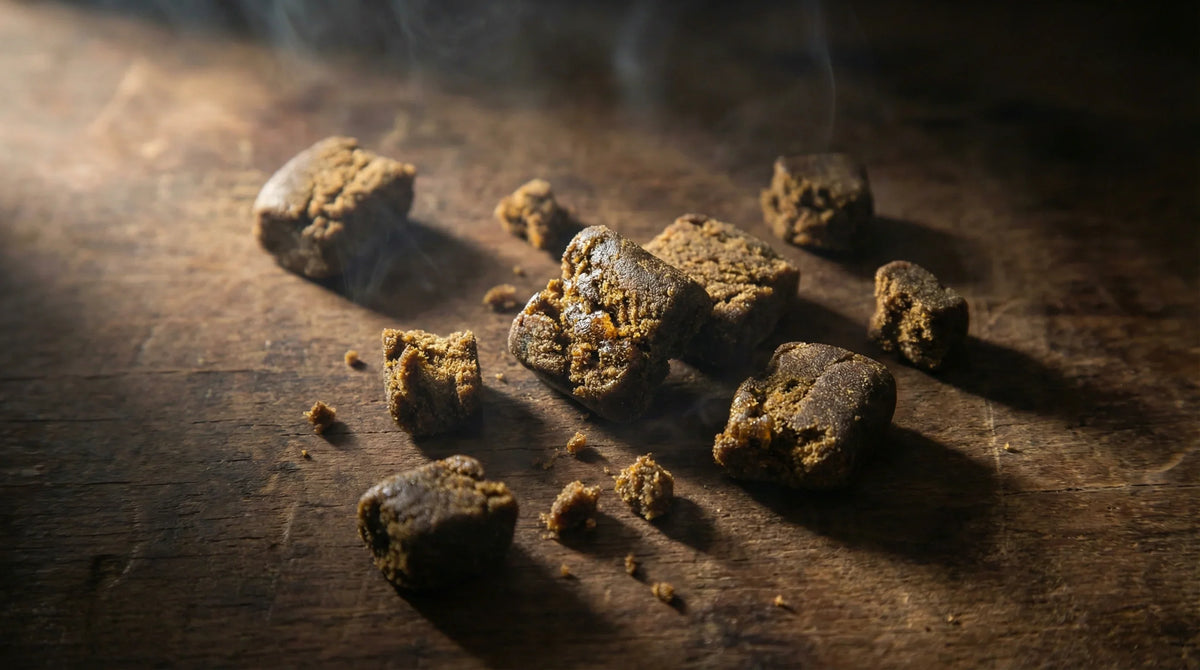
A small piece of resin. Dark. Compact. Inconspicuous. And yet it holds more history than many a museum. Hash has accompanied caravans, shaped cultures, created myths and today ends up in modern CBD shops. Ready for a little journey through time with a detour into the present? Then here are 13 things about hash you should know.
Point 1: hash is older than almost any scene
The first known mention of hashish already appears in Arabic writings in the 10th century. Back then it was of course not a scene product. It was a deliberately produced form of concentrated cannabis. In regions such as Persia and India, people began to collect the plant's resin specifically. They had noticed that the cannabinoids and the aroma are found in the sticky trichomes.
In India this gave rise to charas, rubbed by hand from living plants. In North Africa, the technique of drying and sieving developed later. That was a milestone, because it allowed larger quantities to be preserved and transported. Hash was thus one of the very first forms of “cannabis extract”. You could say it was an early form of plant technology, long before there were labs or stainless steel equipment.
Point 2: the myth of the “Assassins”
In the 11th century, a Shiite group appeared in the Persian Empire that later became known as the “Hashshashin”. Its leader was Hassan-i Sabbah, who resided in the legendary fortress of Alamut. European crusaders later reported on a sect whose fighters were allegedly under the influence of hashish when carrying out political assassinations. This is also said to be the origin of the word “assassin”.
Historically, however, this is disputed. Many researchers assume that the term was used rather as political defamation and should be seen as a kind of medieval propaganda label. Whether the fighters had anything to do with hashish at all is not clearly documented. The only certainty: the myth has persisted. And it has contributed significantly to hash being perceived in the West as mysterious, dangerous and rebellious for a long time. History and legend are so closely intertwined here that they can hardly be separated cleanly.
Point 3: Morocco has shaped hash worldwide
When talking about hash, there is no getting around Morocco. Since the 1960s, the Rif Mountains have developed into one of the most important growing regions in the world. There, the art of drying, sieving and pressing was passed down over generations, often entirely by hand. The famous dry sift method, in which dried plants are rubbed over fine sieves, was perfected and exported from here.
This technique made hash storable, transportable and internationally known. At the same time, a clear quality code for colour, consistency and scent emerged. All of this mattered. Today the focus is increasingly shifting to Europe. Regulated CBD production works with controlled cultivation, modern extraction methods and high-quality manufacturing processes. The craft remains, but the standards have become much more precise.
Point 4: "Famous" people
Every industry probably has its defining faces. In the world of hash, two names keep coming up.
Mila Jansen is known as the “Hash Queen”. In the 1990s she developed the Pollinator machine. It is a device that made the dry sift technique more efficient and reproducible. She brought structure to a scene that had long been purely artisanal and made high-quality resin production accessible to many.
Frenchy Cannoli took a different path. He travelled through India and Morocco, learned traditional methods and combined them with modern knowledge. He became particularly known for so called “temple balls". These are hand-rolled, warm-pressed hash with an intense aroma.
Both stand for respect for the plant, for passing on knowledge and for the idea that hash is more than a by-product. It is a craft with history.
Point 5: how hash is made
At the centre is something tiny: the trichomes. These microscopic resin glands sit on the flowers of the cannabis plant. That is exactly where cannabinoids such as CBD and the aromatic terpenes are formed. Hash is basically nothing other than concentrated trichomes that have been cleanly separated from the rest of the plant material.
Production follows a simple principle: the resin glands are detached mechanically, either by fine sieving (dry sift) or with ice water (frozen hash / bubble hash). The detached resin is collected, dried and then pressed into blocks or balls. The more gently this is done, the better structure, aroma and quality are preserved. Temperature, humidity and clean equipment make the difference between average and premium.
Point 6: CBD hash and the 1% limit
In Switzerland the limit is clear: hemp and products made from it with less than 1% total THC do not count as narcotics. From 1% total THC, hemp falls under the Narcotics Act and is regulated accordingly (BetmVV-EDI, FDHA Ordinance on the Narcotics Lists, SR 812.121.11, Annex 5, list d, as of 13 March 2026). For CBD hash this means: the THC content must be below this value and transparently stated.
Point 7: CBD hash is more concentrated
CBD hash is generally more concentrated than classic CBD flowers. While CBD flowers are often in the range of 10 to 20% CBD, hash frequently ranges between 15 and 30%. This of course depends on production and quality . Because the trichomes are bundled, the aroma is denser, the profile more intense and overall more “compact” in character.
Moderate CBD contents of around 10 to 20% are found mainly in CBD flowers. With hash, higher concentrations are common, often together with a denser terpene profile.
Point 8: quality starts with cultivation
Good hash is not created during extraction, but months earlier in the field. Light, soil and water determine how many trichomes the plant forms and how intense its terpene profile becomes. Sunny locations and well-drained, nutrient-rich soil create the basis for strong, resinous flowers.
Timing is also decisive. If harvested too early, the cannabinoid profile is not yet fully developed. If you wait too long, the aroma suffers. After harvest, clean drying is what counts: ideally the plants are hung up on the whole stem so that terpenes are preserved as far as possible.
The bottom line: hash can only be as good as the raw material it comes from. That already starts with the seeds.
Point 9: storage matters
Hash is more sensitive than it looks. Heat and light attack exactly what makes it special: the terpenes and cannabinoids. If it is stored too warm, aroma compounds evaporate faster. Direct light also accelerates the breakdown of the compounds. The result: less scent, less character.
Cool, dark and airtight storage is ideal. A glass container in the cupboard beats any plastic bag. Plastic is often not completely airtight, aroma is lost and the material can take on odours. If you value quality, protect your hash from heat, oxygen and light, so the profile stays as stable as possible.
Point 10: the role of the trichomes
At its core, hash is nothing other than bundled trichomes. These tiny, crystal-like resin glands sit on the flowers of the cannabis plant and contain cannabinoids such as CBD as well as the aromatic terpenes. They are the most resinous part of the plant. When making hash, exactly these glands are separated as cleanly as possible from the rest of the plant material.
The more precisely this isolation succeeds, the higher the quality of the result. Fewer plant residues mean a purer structure, a more intense aroma and a clearer profile. You can often recognise good quality by the fine, sandy or slightly oily consistency, depending on the production method.
Point 11: terpenes are the real star
Many people look at the CBD percentage first. Understandable, but only half the truth. The aroma experience comes mainly from terpenes. They determine whether a hash comes across as earthy and spicy or sweet, fruity and almost creamy.
This interplay defines its character. Two products with the same CBD content can smell and taste completely different, simply because the terpene profile is different. This is exactly where you see how much craftsmanship and care really go into it.
Point 12: hash comes in many variants
Not all hash is the same. Appearance, consistency and aroma depend heavily on the production method. From dry and crumbly to soft and creamy, everything is possible. What matters is how the trichomes were obtained. Here are the most important production methods at a glance:
-
Dry sift
Dry-sieved trichomes. Usually darker, a traditional look, often earthy and spicy in profile. -
Ice-O-Lator / bubble hash
Extracted with ice water. The cold detaches the trichomes particularly cleanly from the plant material. Often lighter, finer and very pure. -
Frozen hash (fresh frozen)
Plant material deep-frozen directly after harvest. This preserves sensitive terpenes better. The aroma often comes across as fresher and closer to the living plant. -
Hand rubbed (e.g. charas)
Old school method. Resin is rubbed directly from the plant. Soft, oily, intense.
Point 13: hash is premium lifestyle today
In the regulated CBD sector, the image of the crumbly street product has long been a thing of the past. Sustainable cultivation, controlled processes and clearly declared values are standard, and that is exactly why the community keeps growing.
CBD hash now stands for care and transparency. For people who are interested in terpene profiles, pay attention to quality and want to know where their product comes from. The scene has changed noticeably. Less rebellion, more balance. More focus on craft and plant. When traditional techniques meet modern quality standards, something with real character is created.




Comments (0)
There are no comments for this article. Be the first one to leave a message!